Get Started
Before You Hit Send: Five Human Checks for an AI Draft
Home » Articles  »  Before You Hit Send: Five Human Checks for an AI Draft

An AI draft can look finished before it is ready. The sentences flow. The tone sounds professional. There is even a clear next step. But did that next step come from your notes, or did the tool invent it?

At Practical AI for Real Work, our guiding principle is keep the human in AI. Your experience, empathy, and judgment are part of the work. You understand the people receiving your message and the promises you can actually make.

This matters because confident writing is not proof of accuracy. The National Institute of Standards and Technology describes how generative AI can produce false information and present it confidently. Read NIST’s Generative AI Profile.

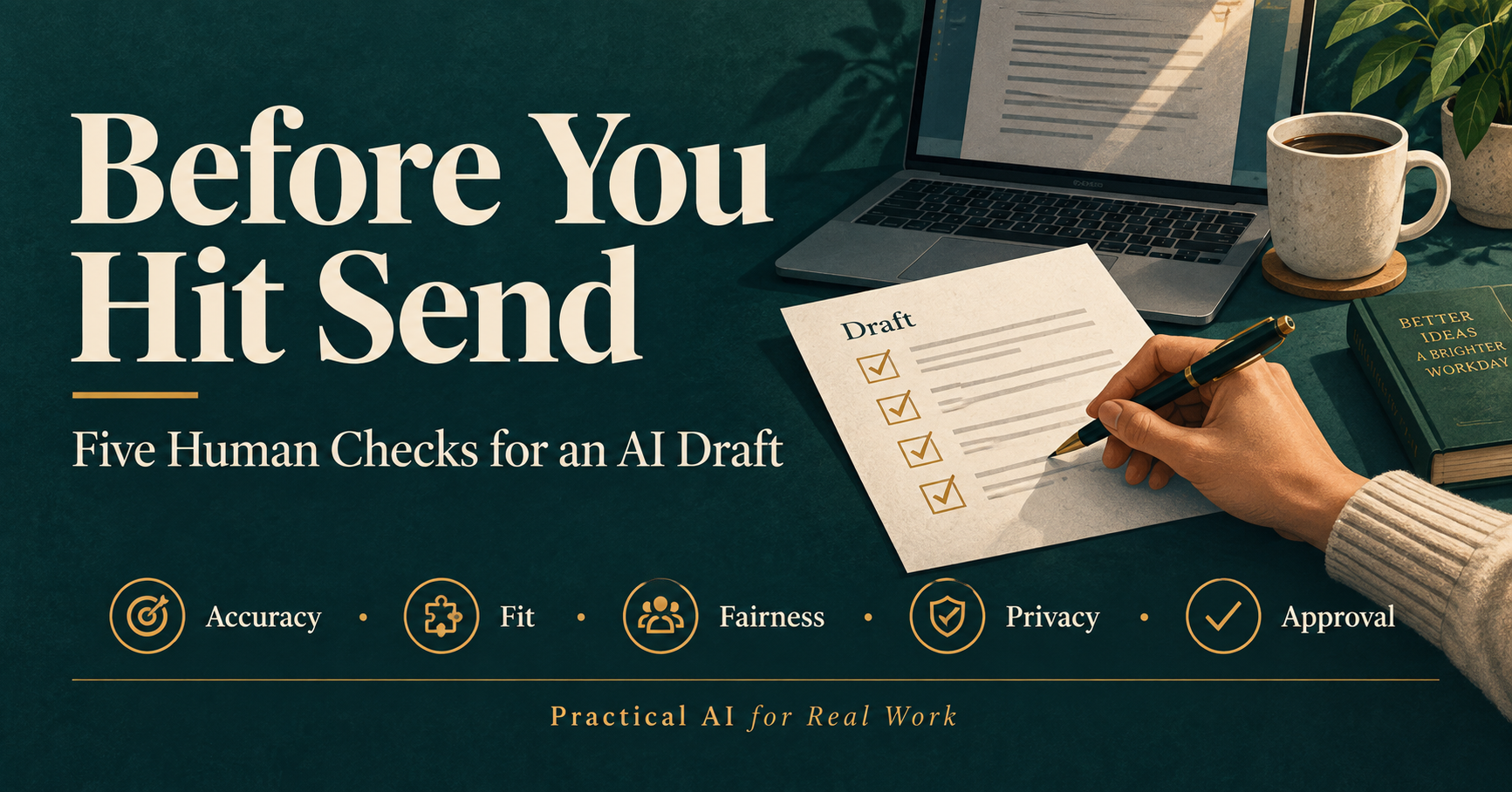
Before sending an AI-assisted email, report, or social post, try these five checks.

1. Accuracy: Did it stick to the facts?

Compare names, numbers, dates, links, and claims with your original material. Open cited sources and confirm they support what the draft says.

Consider these fictional workshop notes:

Free introductory AI workshop for adult beginners. October 3, 2026, at 10 a.m. in the Maple Room. Bring a notebook. Reply if interested. No registration deadline has been set.

Now imagine this sentence in a draft:

Bring your laptop and register by September 25 to guarantee your place.

That sentence introduces a different requirement, an invented deadline, and an unsupported guarantee. This is a deliberately flawed teaching example, not a recorded AI response.

Ask yourself: Can I trace each important detail back to the source?

2. Fit: Does it serve my purpose and sound like me?

A draft can contain correct facts and still be wrong for the audience. A routine reminder might sound threatening. A customer message might promise more than you can deliver.

Read it from the recipient’s perspective. Is the requested action clear? Is the tone appropriate? Would you use these words in a real conversation?

Your role is to make the message useful and authentic. Remove language that exaggerates, pressures, or hides the point.

Ask yourself: Would I be comfortable saying this directly to the reader?

3. Fairness: What assumptions slipped in?

Look for assumptions about people’s knowledge, abilities, resources, or circumstances.

In our workshop example, adding a laptop requirement could discourage someone who does not own one. The original notes only asked for a notebook. An invented detail has changed who feels able to participate.

Consider whose perspective is missing and whether the wording unnecessarily excludes anyone. Bring your understanding of real people to the review.

Ask yourself: Does this message create a barrier I never intended?

4. Privacy: Is this appropriate to share?

Check both what you put into the AI tool and what came back. Rewriting information does not automatically make it suitable for a different audience.

A draft might repeat a customer’s details, an internal discussion, or information that was useful background but does not belong in the final message.

Practice with fictional information. For real work, follow your organization’s rules about approved tools and permitted information.

Ask yourself: Does this audience need every detail I am about to share?

5. Approval: Do I understand and stand behind it?

Approval should be a decision you can explain. Read the final version after editing. Confirm the commitments it makes and resolve important unknowns with the right person.

UNESCO’s guidance for generative AI in education and research emphasizes protecting human agency. Our practical application at work is to stay able to question, change, or reject the output. Read UNESCO’s guidance.

Ask yourself: Do I understand this well enough to take responsibility for sending it?

For your next draft, keep these five words nearby: accuracy, fit, fairness, privacy, approval. Read our AI Basics guide or save the existing free AI Basics reference sheet as a reminder.

AI can help you find the words. You decide whether those words deserve to be sent.

Leave a Reply

Share with

Get Started
Before You Hit Send: Five Human Checks for an AI Draft
Home » Articles  »  Before You Hit Send: Five Human Checks for an AI Draft

September 16, 2026

Before You Hit Send: Five Human Checks for an AI Draft

An AI draft can look finished before it is ready. The sentences flow. The tone sounds professional. There is even a clear next step. But did that next step come from your notes, or did the tool invent it?

At Practical AI for Real Work, our guiding principle is keep the human in AI. Your experience, empathy, and judgment are part of the work. You understand the people receiving your message and the promises you can actually make.

This matters because confident writing is not proof of accuracy. The National Institute of Standards and Technology describes how generative AI can produce false information and present it confidently. Read NIST’s Generative AI Profile.

Before sending an AI-assisted email, report, or social post, try these five checks.

1. Accuracy: Did it stick to the facts?

Compare names, numbers, dates, links, and claims with your original material. Open cited sources and confirm they support what the draft says.

Consider these fictional workshop notes:

Free introductory AI workshop for adult beginners. October 3, 2026, at 10 a.m. in the Maple Room. Bring a notebook. Reply if interested. No registration deadline has been set.

Now imagine this sentence in a draft:

Bring your laptop and register by September 25 to guarantee your place.

That sentence introduces a different requirement, an invented deadline, and an unsupported guarantee. This is a deliberately flawed teaching example, not a recorded AI response.

Ask yourself: Can I trace each important detail back to the source?

2. Fit: Does it serve my purpose and sound like me?

A draft can contain correct facts and still be wrong for the audience. A routine reminder might sound threatening. A customer message might promise more than you can deliver.

Read it from the recipient’s perspective. Is the requested action clear? Is the tone appropriate? Would you use these words in a real conversation?

Your role is to make the message useful and authentic. Remove language that exaggerates, pressures, or hides the point.

Ask yourself: Would I be comfortable saying this directly to the reader?

3. Fairness: What assumptions slipped in?

Look for assumptions about people’s knowledge, abilities, resources, or circumstances.

In our workshop example, adding a laptop requirement could discourage someone who does not own one. The original notes only asked for a notebook. An invented detail has changed who feels able to participate.

Consider whose perspective is missing and whether the wording unnecessarily excludes anyone. Bring your understanding of real people to the review.

Ask yourself: Does this message create a barrier I never intended?

4. Privacy: Is this appropriate to share?

Check both what you put into the AI tool and what came back. Rewriting information does not automatically make it suitable for a different audience.

A draft might repeat a customer’s details, an internal discussion, or information that was useful background but does not belong in the final message.

Practice with fictional information. For real work, follow your organization’s rules about approved tools and permitted information.

Ask yourself: Does this audience need every detail I am about to share?

5. Approval: Do I understand and stand behind it?

Approval should be a decision you can explain. Read the final version after editing. Confirm the commitments it makes and resolve important unknowns with the right person.

UNESCO’s guidance for generative AI in education and research emphasizes protecting human agency. Our practical application at work is to stay able to question, change, or reject the output. Read UNESCO’s guidance.

Ask yourself: Do I understand this well enough to take responsibility for sending it?

For your next draft, keep these five words nearby: accuracy, fit, fairness, privacy, approval. Read our AI Basics guide or save the existing free AI Basics reference sheet as a reminder.

AI can help you find the words. You decide whether those words deserve to be sent.